

Fractional engagements are all the rage these days, from fractional CFOs to fractional CMOs. In fact, just about every “seat” within a company’s C-suite has fractional representatives who are eager for the chance to jump on the bandwagon and help fill your company’s growing needs. As the thinking goes, “why pay a full-time salary, benefits and associated overhead costs when you can find a fractional person or company to fill that role?”
At first glance, it may make perfect sense. But when it comes to some business initiatives— especially branding and marketing—the perceived and purported benefits don’t always add up. Here’s why:
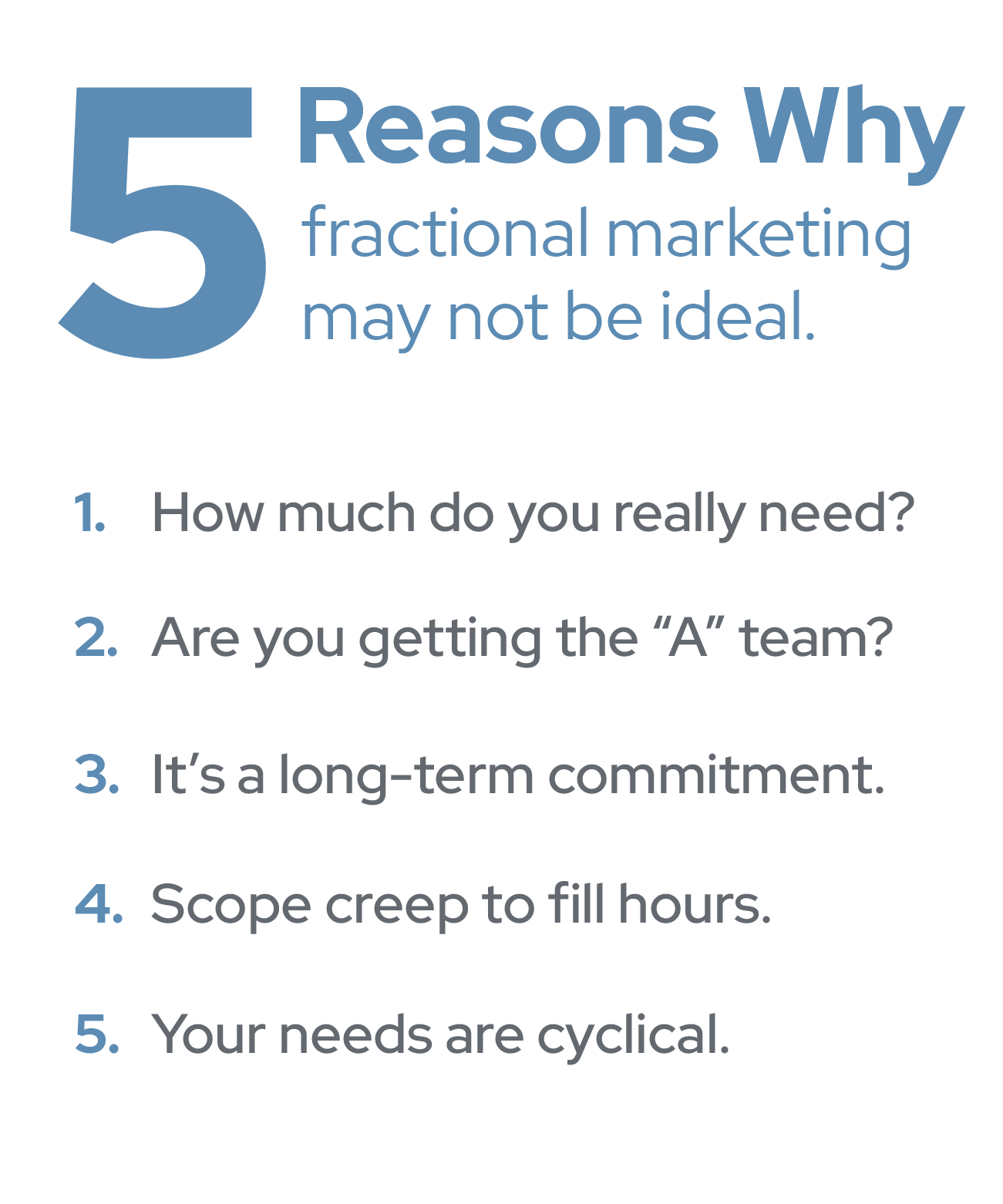
1. Do you really need $100,000+ of brand, design and marketing in a given year?
This a conservative estimate, as many agencies will want you to commit to a minimum of 60–90 hours per month. What’s more, this amount doesn’t include third-party expenses such as production costs—printing, outside photography, videography, coding, or even paid search or media placement. Add in those additional costs and your actual marketing spend goes much higher. What you’re really paying for is additional support staff—and you might already have someone internally to do the job—they might just need help making their ideas a reality.
2. You are not necessarily guaranteed the “A” team on your account.
Sure, you met with the agency executives and senior leadership who know their stuff. The problem is that once the pitch has been won and the engagement letter signed, the actual “work” is handed off to junior level employees—who may or may not be as good at solving your challenge. The ones who sold you on the engagement are now off seeking the next shiny object or client instead.
3. You are forced into a long-term commitment that may be one-sided.
Retainers (marketing jargon for a long-term contract) are great for consultants and the companies pitching fractional engagements—they guarantee consistent income and even help prop up business valuations. On the client side, a retainer can be beneficial because the company doesn’t need to add employees, equipment or office space (not to mention additional benefits and taxes). It keeps their expenses consistent month-to-month and helps with annual budgeting.
The risks of a retainer agreement however, include:
• Clients agree to pay for a certain number of hours each month, regardless of whether they are actually used. As much as transparency in billing is promoted or discussed, at the end of the day it often comes down to clients having to hold the consultant or agency accountable and request detailed reports.
• What happens if the work produced is not what is expected or promised? Getting out of a Retainer agreement that may not be beneficial is sometimes hard to do. Sure, there are exit clauses and remediations that can be made, but at the end of the day, these are at best a stall tactic—both the consultant and the client know that the relationship is broken—and your marketing funds will still be tied up for at least a month or two. And do you really expect to be getting the best work while you’re in the process of a break-up?
4. Project recommendations might be based on the need to fill monthly hours, rather than solve an actual business need. Un-proven or risky tactics, while being pitched as “creative, bold or innovative,” might simply be a way to gap-fill hours and be an unnecessary drain on your company’s resources. Not all projects will move the needle in terms of brand awareness, customer engagement, and sales improvement. As one former client told me of their previous agency experience, they “felt like they got nothing they needed and everything they didn’t.”
5. The sales cycle is cyclical, and so are your brand and marketing needs.
Like clockwork, there are certain times of the year when your company needs help executing its marketing strategy— whether for upcoming tradeshows, a slew of proposal requests that all seem to come in at once, or an annual meeting or initiative. These needs are seasonal, and typically over a period of a few months, not an entire year. Does it make more sense to hire help as-needed, or have someone who may be sitting idle—while charging you for that down-time?
Sometimes all you need is a little help from your friends.
There’s a reason why you may be considering a fractional consultant or company—maybe you don’t have the budget to hire a senior level executive to fill your brand and marketing role. Perhaps you already have someone (such as a Marketing Coordinator or Sales Director) who is perfectly capable of handling marketing efforts and has great ideas, but lacks the bandwidth to execute on them.
Maybe you’ve had a bad experience working with an independent marketing consultant or freelance designer in the past; think that they are not dependable (since they might have a regular day job and “moonlight” afterhours on the side); or they could never know the complexities of your business (your products, services and customer benefits). Whatever the reason, it’s worth considering the trade-offs before signing a long-term commitment.
That’s where we come in.
We partner with entrepreneurs, business owners and marketing professionals of established small- to medium-size businesses who desire a professional, consistent and unique image in the marketplace. Clients who want to stand out from the crowd with creative solutions and build brands that are truly remarkable and engaging. We don’t work on retainers (although we’re open to one—only if it makes sense), but we can help evaluate your needs, establish priorities and timelines, and then execute on those deliverables as needed alongside your executive leadership and marketing team.
To see how Indicia can help on a seasonal- or project-by-project basis, please email for more information and to set up a no-nonsense meeting to discuss.
Indicia is a collaborative of highly experienced, highly specialized independent creatives. We partner with other experts to create a marketing “dream team” for your organization—from writers and photographers to printers and web developers—and everything in between. We manage the sub-contractor relationship to ensure your overall brand and marketing objectives are being met while allowing you to work directly with other domain-specific experts to deliver on your marketing plan.